
Between Structure and Metamorphosis: Andrea V. Wright Opens Up
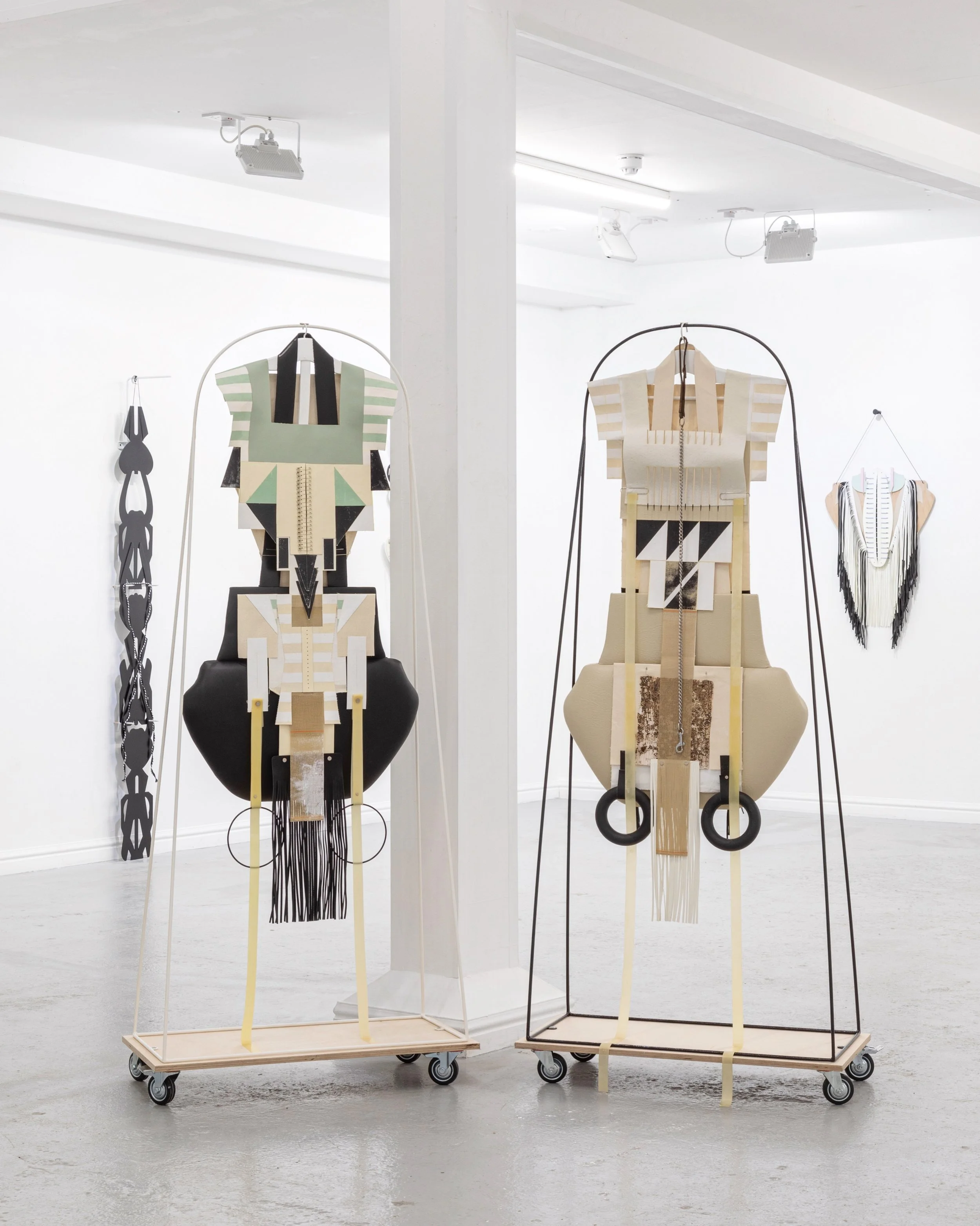
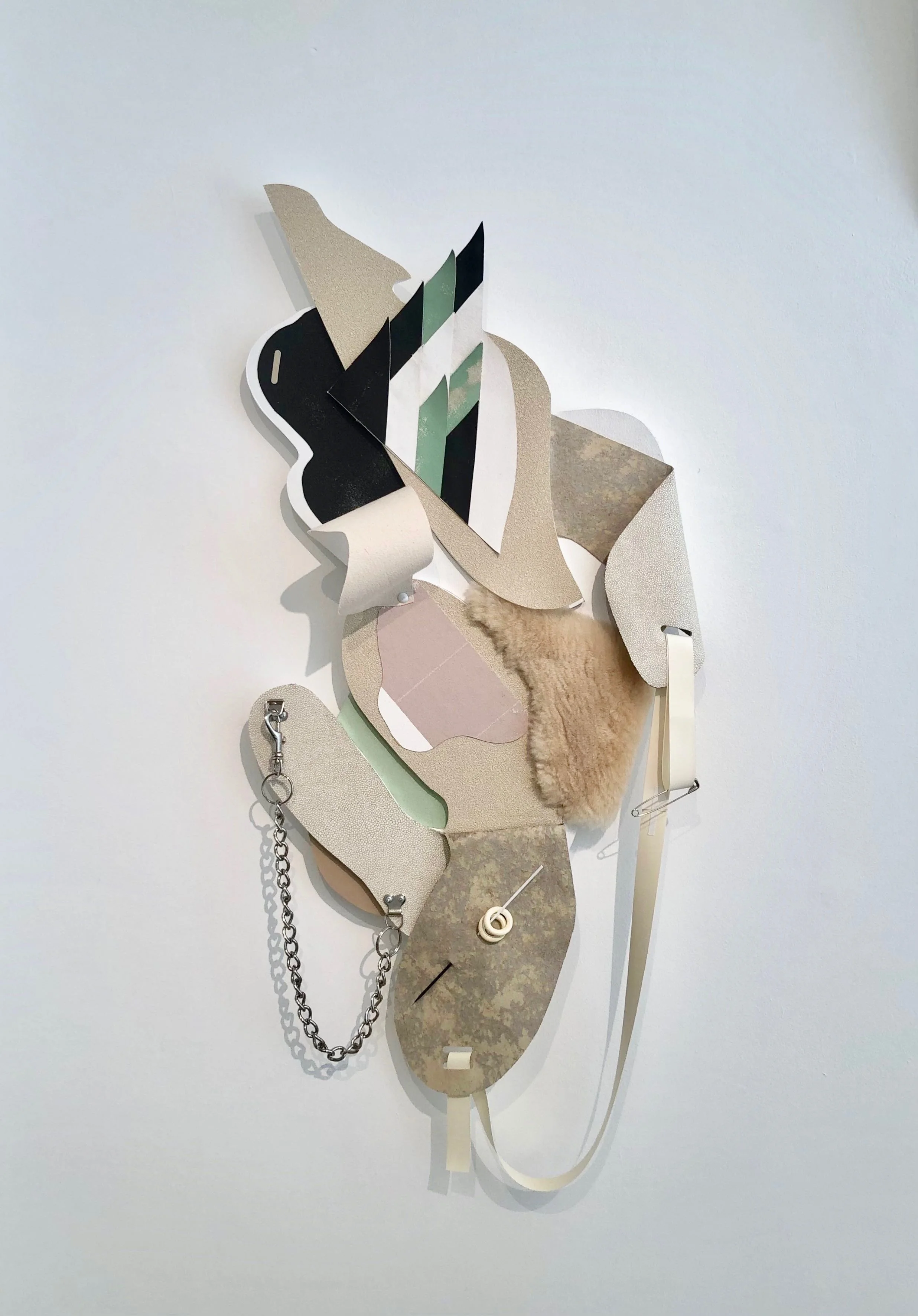
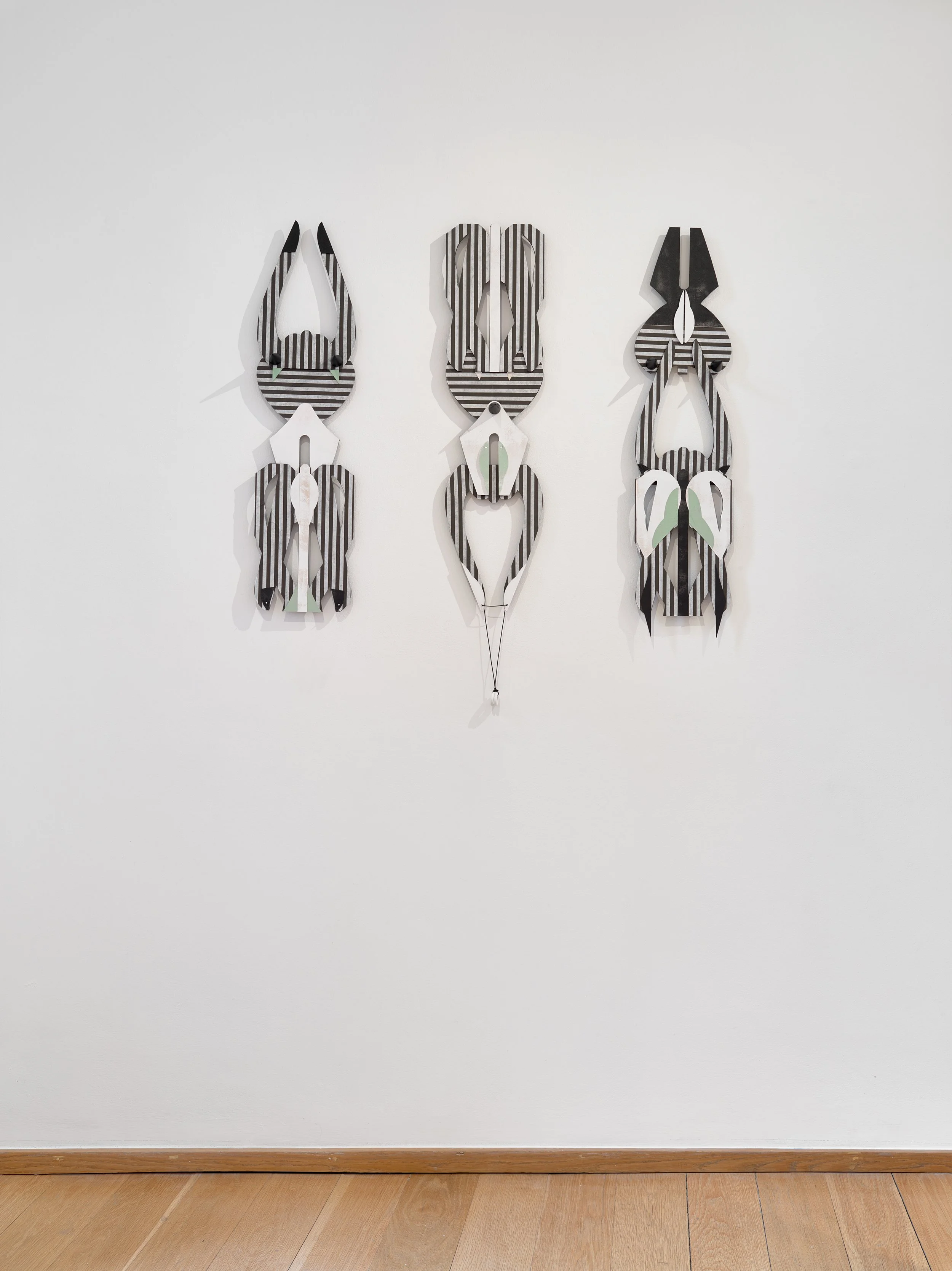
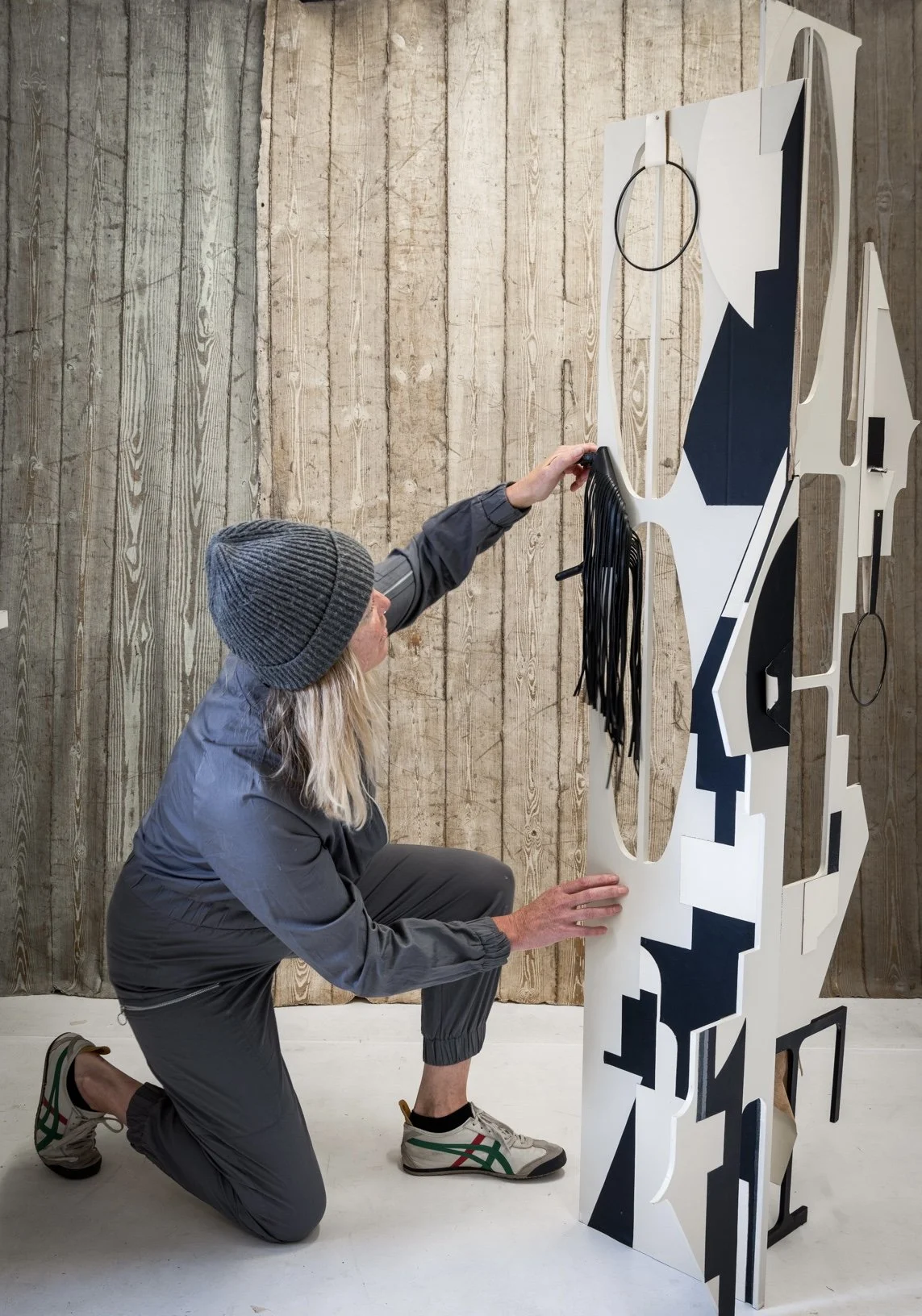
Artist Andrea V. Wright’s practice is grounded in a materialist, evolving, and spiritual approach, where found objects, accumulated fragments, and discarded detritus are brought into dialogue with raw and industrial materials such as latex, steel, wood, and fabric. Through processes of wrapping, pinning, draping, and assembling, her work articulates a complex language of surfaces oscillating between control and vulnerability, precision and gesture.
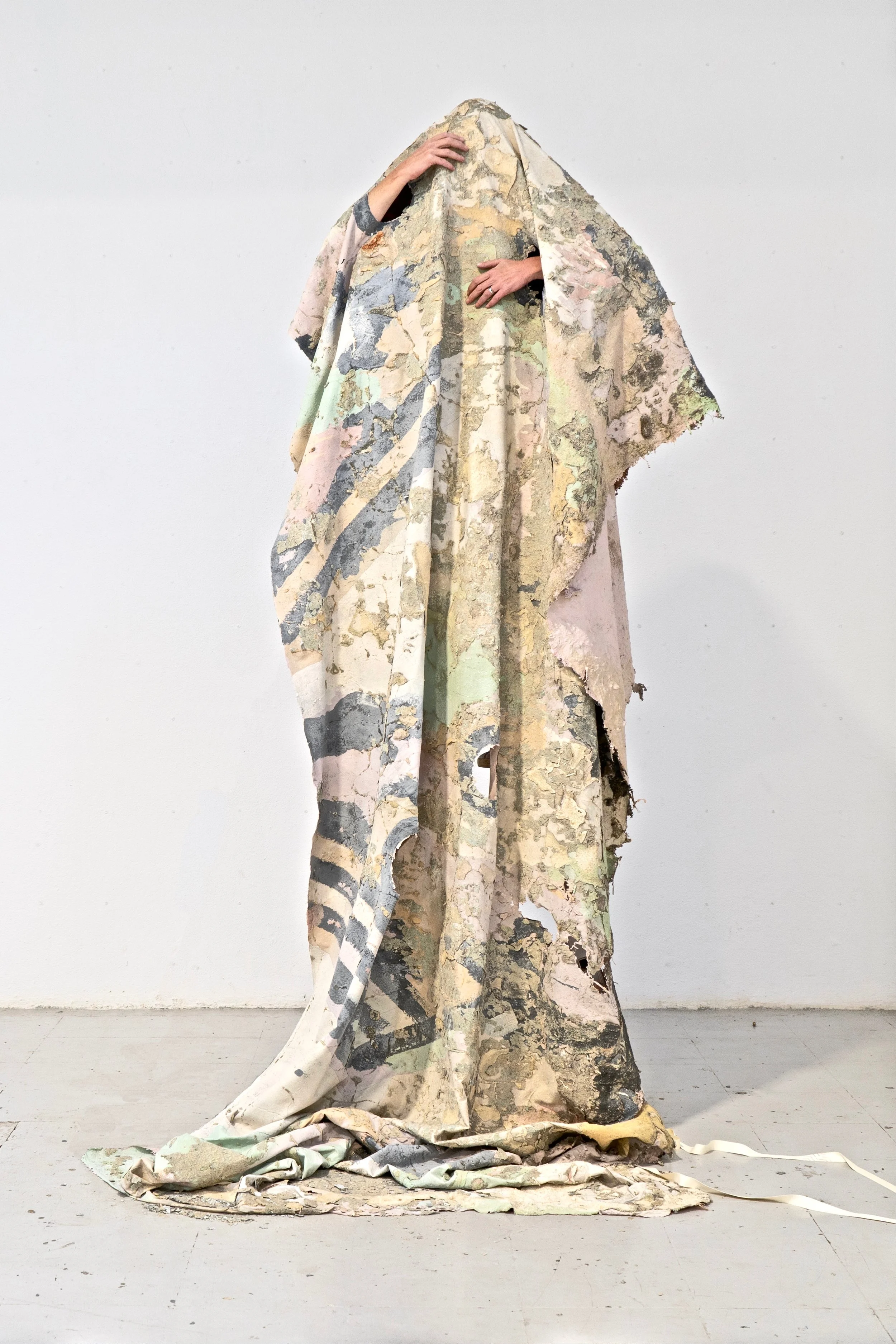
Drawing on a background in fashion, styling, and music culture, Wright’s work incorporates strategies of drapery, tactile manipulation, and illusion, allowing materials to perform both structurally and metaphorically. Geometric and organic references coexist within her compositions, generating hybrid forms that suggest a veiled architecture — one that echoes bodily posture, stance, and internal structure. Rigid substrates are held in tension with soft, supple skins, evoking the ways in which bodies are clothed, protected, or concealed, and how material surfaces register time, pressure, and site-specific context.
At the heart of Wright’s practice lies an exploration of liminality: the thresholds between visibility and concealment, becoming and disintegration, presence and absence (a concept describing a transitional period or state, situated at a threshold between two distinct states, statuses, or places, characterized by ambiguity, indeterminacy, and flux, as in a rite of passage or an intermediate physical space such as a corridor or airport). Her works operate as vertical stages upon which crafted and industrial materials are choreographed, revealing moments of suspension where meaning remains open. These in-between states are imbued with a subtle intensity, allowing multiple, often contradictory voices to emerge through the assemblage of materials.
The formal language of Wright’s work is deliberately restrained, yet it is disrupted by handmade, haptic interventions that insist on the presence of the body — both as subject and as agent. This interplay produces a tactile register that situates the work within a broader inquiry into the relationship between corporeality, environment, and emotional space. Structure and surface, bone and skin, architecture and flesh become intertwined, positioning the work as both materially grounded and conceptually speculative.
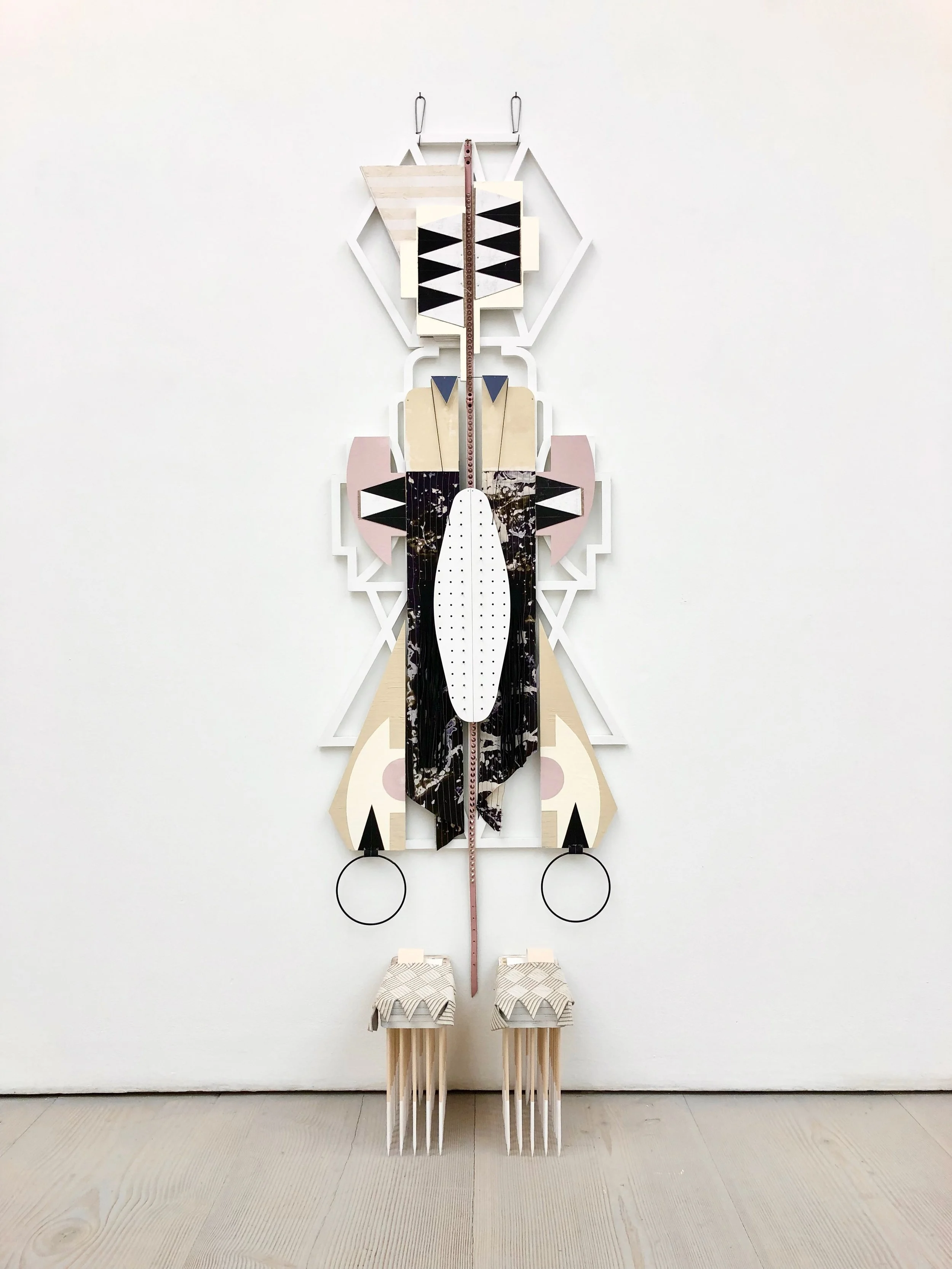
Your sculptures seem to celebrate the body, and the notions of inside/outside as well as metamorphosis appear to play a central role in your practice. Could you explain this thought process and how it guides your creations?
Andrea: The body plays an important role in my approach to making work. I consider it in terms of proportion, line, and surface, as well as its spatial and material relationship to architecture, both physical and psychological. I am interested in the multiple roles and positions we are required to adopt as we navigate an increasingly complex environment. Camouflage, pretence, protection, seduction, and other behaviours inform my work through the use of materials that evoke bodily and architectural forms and what these materials have the power to suggest.
Life drawing was a significant part of my art education, and I preferred short poses because the model could hold more challenging or uncomfortable postures. Capturing the distribution of weight, the angle of the hips, shoulder line, foreshortening, proportion, etc., was essential for the drawing to “work.” The structure of the body is a complex object capable of forming a multitude of compound angles. Perhaps, in retrospect, my steel, wood, and latex constructions have a direct relation to the figure while also forming a display substrate.
Ultimately, the body is an ever-changing, shedding, complex form, and in my work, I strive to crystallise this constant metamorphosis through materials, methodology, nuance, and illusion.
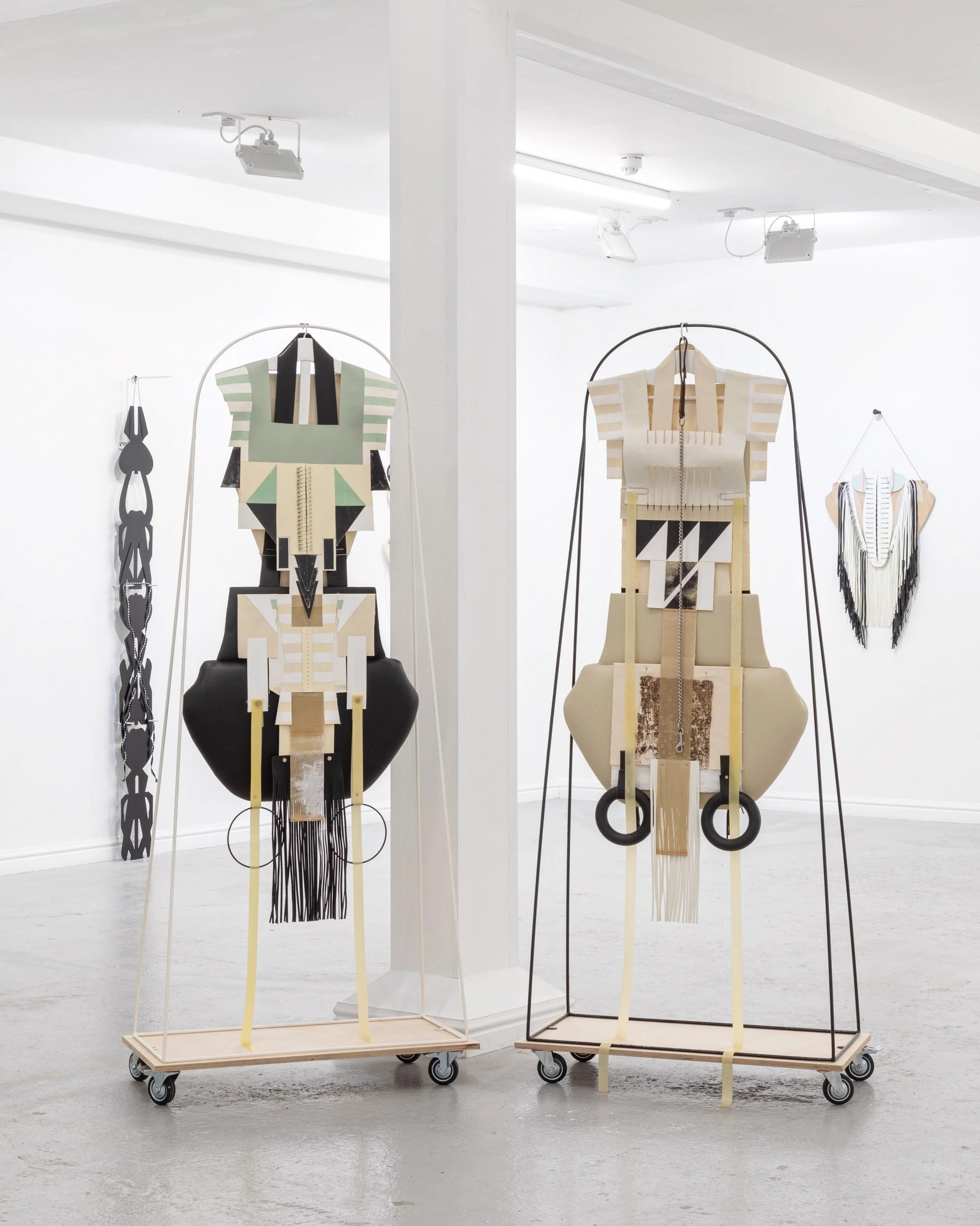
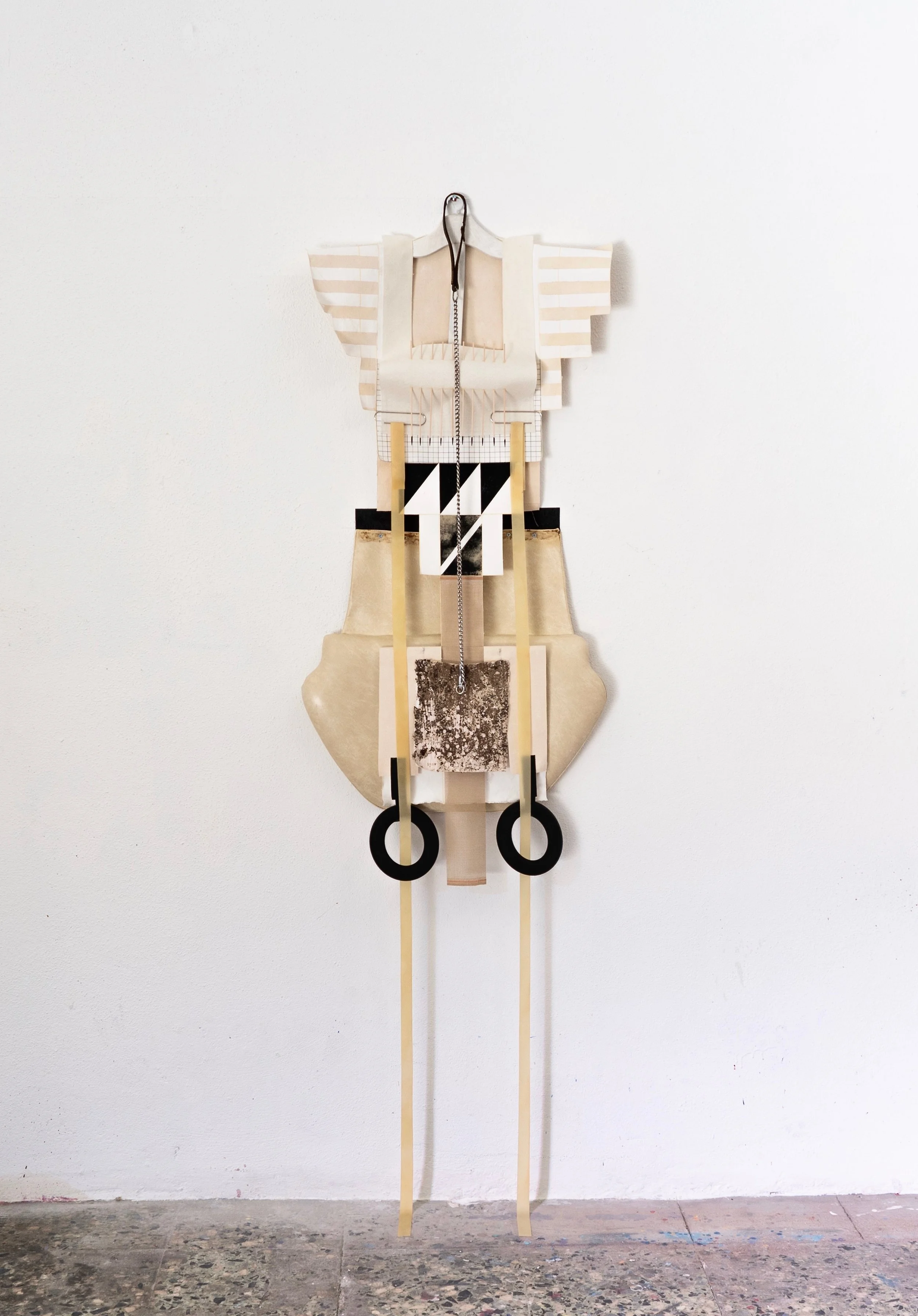
Fashion — through textiles, materials, and the presence of garments — also appears as a structuring element in your work. The garment, like armour, rests upon a chassis that takes on a totemic quality, creating an encounter between body and spirit. Your 2021 pieces even seem to evoke an esoteric or spiritual dimension. Does this interpretation align with your intention?
Andrea: Growing up near London in the 1980s, street style, culture, and tribal identity were everywhere. Authenticity and attention to detail — from the cut of clothes to hair — had to be perfect. I used to rummage through jumble sales and charity shops for vintage clothes and accessories and sell them for pocket money. After leaving Chelsea College of Art in 1994, I worked as an assistant to a fashion stylist. Handling garments by Alexander McQueen and Hussein Chalayan gave me an understanding of the craft and construction involved in high fashion and accessories. My eye was constantly absorbing, and the tactile handling of different fabrics, leathers, and threads has influenced my thinking on material, proportion, and shaping.
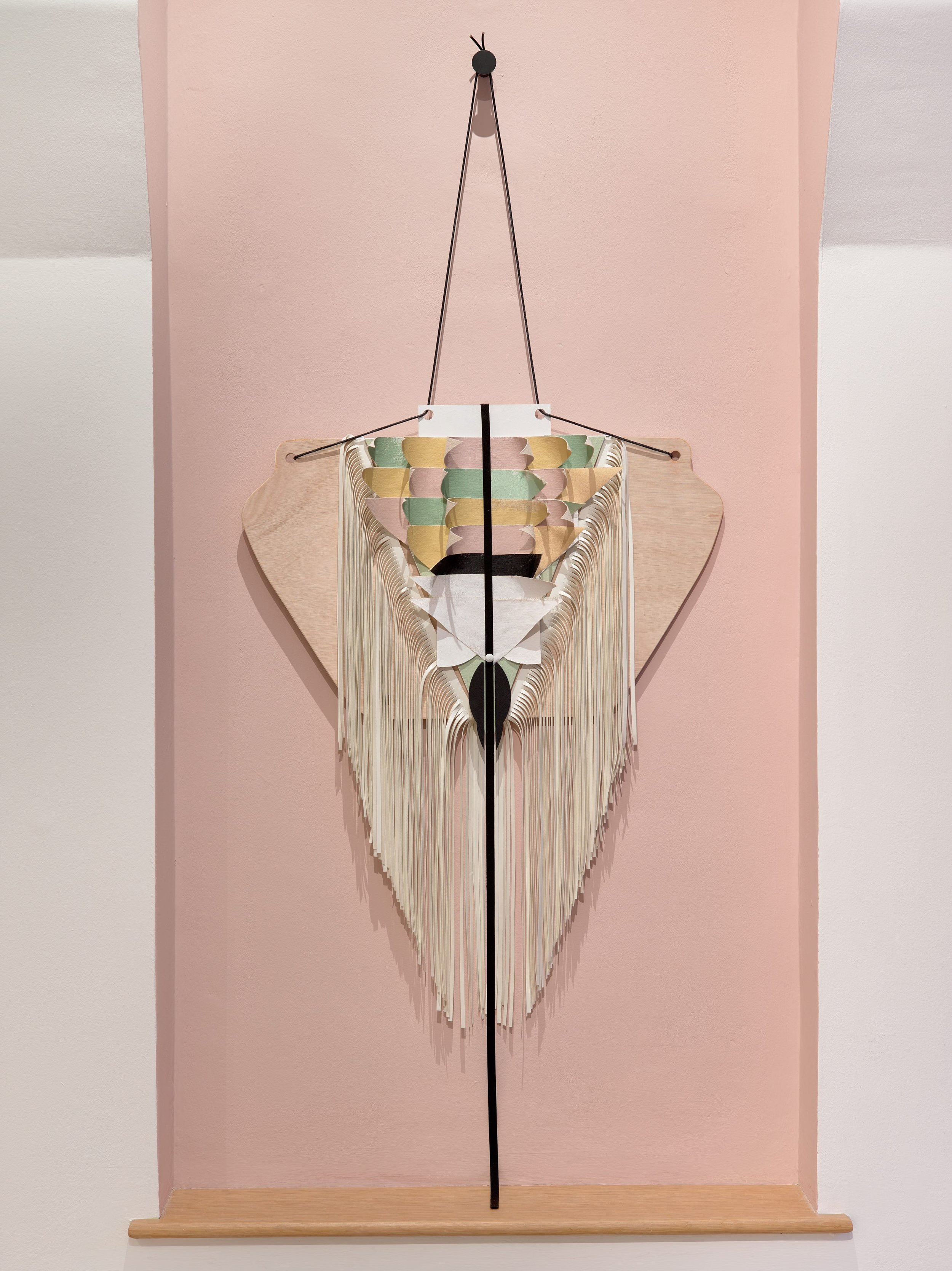
During the 2020/21 pandemic, my work became more personal, and I wanted to draw on my own experiences. The slowing down made me more aware of the rituals of dressing. With masks being mandatory, my imagination turned to costume, power dressing, and shields. I became preoccupied with ideas of vulnerability, armour, and protection, alongside scrap assemblage and making pieces from found objects. A part of me was in survival mode, and my work became more symbolically figurative or “of the body,” without the figure ever being present. With a structural support, “chassis,” or substrate underpinning much of my output, bodily proportions became more important during this period. There was an urgency in making where I was essentially addressing myself. I am a spiritual being. Raised in Catholic convents, of Irish heritage, I have, as an adult, become very interested in Tibetan Buddhism. It is therefore through the subconscious that this dimension appears in my work, particularly in my more symmetrical structures. I don’t set out to make esoteric work, but I do seek to evoke an aura or phenomenological resonance, which is why I often use found objects in my work.
The thorax is a recurring motif in your work. Highlighted in many pieces, it seems to symbolise the body, vital energy, and strength, while its separation from the head — and thus from the mind — suggests a certain autonomy of the body, perhaps even a dominance of the physical over the mental. How do you analyse this dynamic within your practice?
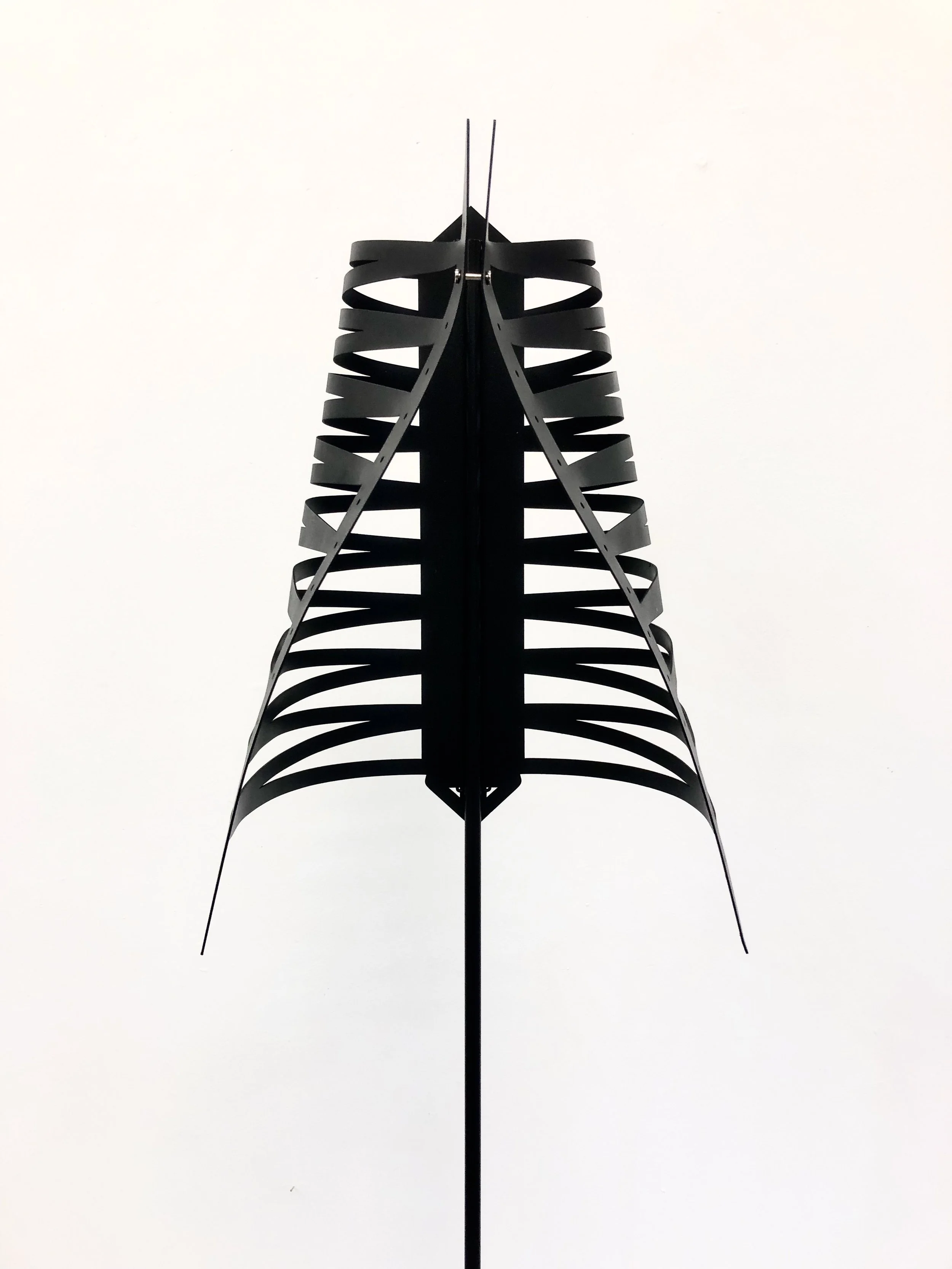
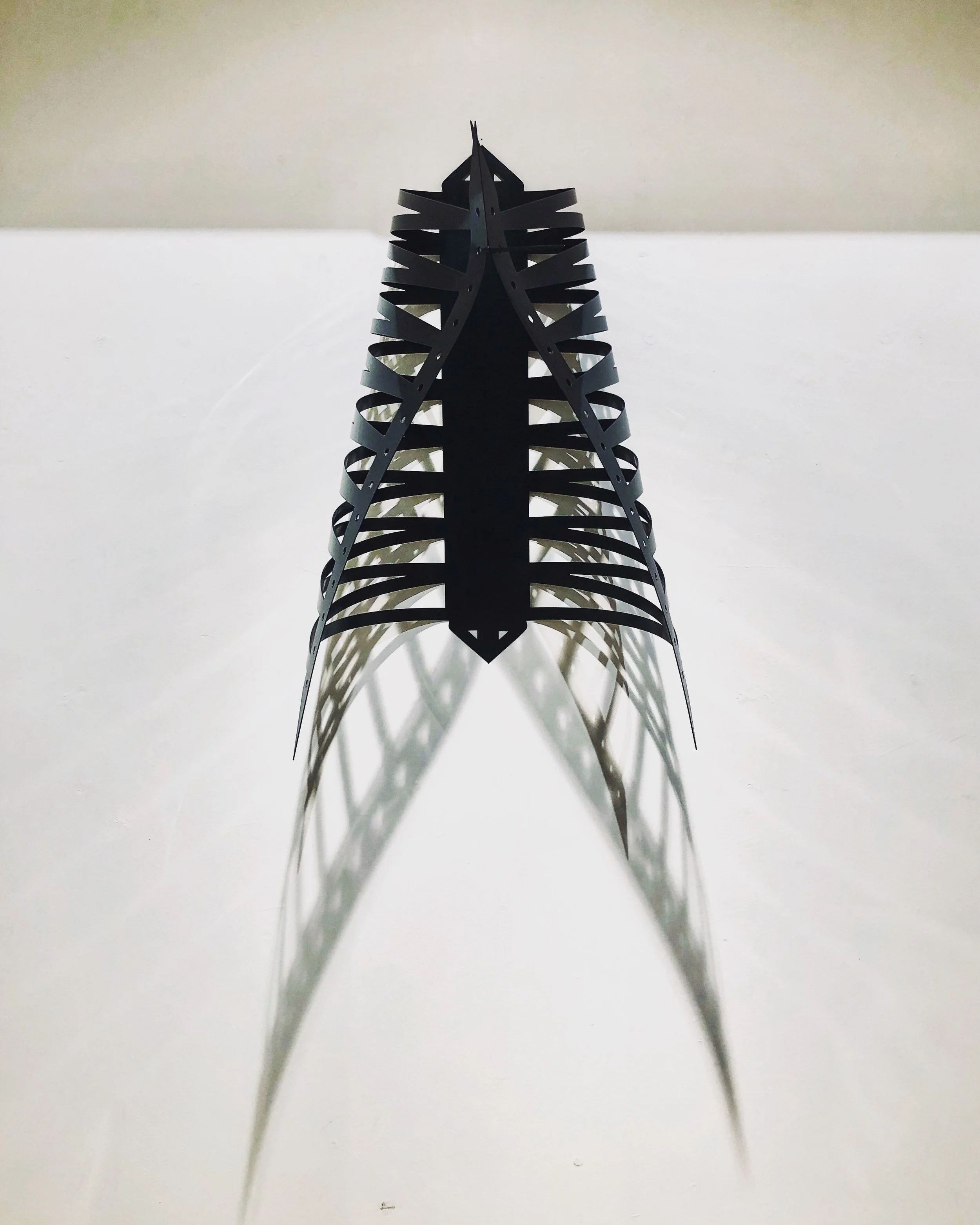
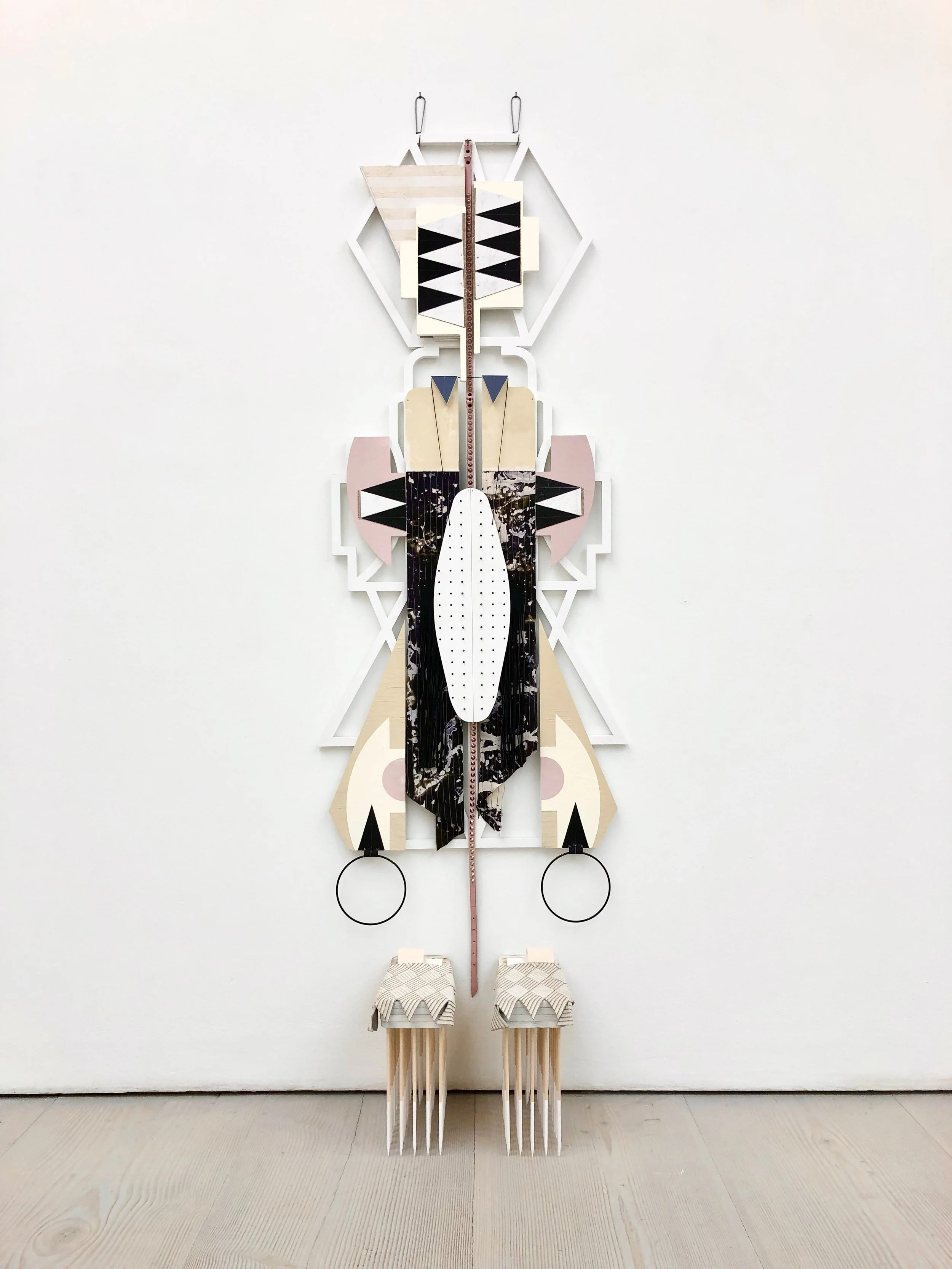
Andrea: The thorax inspired a series of sculptures called Nervure, which I began in 2019 during a residency in central London. It was the hottest summer on record, and the city had a tense, edgy energy. Travelling on the Tube among sticky bodies, I felt the need for protection or self-defence. Nervure was born out of that experience. I wanted to create a sculpture based on a wearable object. Nervure relates to the body and its skeletal structure, particularly the ribcage. Its rigid, chrysalis-like form can serve as protection while also functioning as a partial architectural exoskeleton. The word “nervure” derives from the French term for vein or rib, describing the structural support of a plant or animal.
By isolating the torso in this way, the sculpture becomes less literally figurative than if I had attached other skeletal body parts. I see Nervure as an analogue of the ribcage, an exoskeleton that may appear aggressive but actually serves to protect, shielding the soft innards of the torso and its vital organs. This exemplifies the duality you mention — it may look constricting, almost corset-like, but its function is to protect and preserve.
Geometry also plays a significant role in your aesthetic research. You explore both symmetry and asymmetry, generating a form of duality: some works evoke randomness, while others adopt a more binary language in which shapes respond along an axis. For you, is this tension between order and disorder a contradiction or a complementarity?
Andrea: Balancing geometry is challenging, and it’s fascinating how delicate that balance can be. For me, it is in the proximity of lines, the space between them, that activation occurs, whether asymmetrical or symmetrical. I require freedom to move between states in order to work with integrity. Tensions and dualities are central to my understanding of myself and the objects around me. There are multiple voices in my work that seek to be heard, often expressed through these tensions, contradictions, and dualities. The precarious balance between order and disorder has preoccupied much of my life; I need both.
Finally, a few years ago your work subtly explored collisions between lines and curves, soft surfaces and structures, geometric and organic forms. Are you currently exploring new creative territories or exhibition projects that you would like to share?
Andrea: In 2026, I will continue working with structure and textiles. Several works from the past five years have not yet fully realised their exploration of materiality, garment, structural pattern, and the collisions you mention. With my new studio in Somerset, UK, I am in a better position to develop ideas that were on hold. As a former vocalist, I am also interested in exploring sound — my voice has lain dormant for too long, and I want to experiment with it purely as sound.
My work will be featured in a Thames & Hudson publication titled Textile X Art: How Textiles Are Shaping Contemporary Art, due for release in February 2026, and in January as part of a collage exhibition GAS at the post ROOM gallery in London, before moving to Bruton, Somerset. Other projects are also in development… stay tuned.




Andrea V. Wright
Visual artist based in Somerset
Selected Exhibitions
International solo and group shows (2017–2024), including:
Saatchi Gallery (London), Thames Side Studios (London), Foundry Gallery (London), Galeria Nordes (Spain), ARCO Madrid (Digital), AIR Gallery (Manchester)
Awards & Distinctions
Jerwood Drawing Prize
Royal Society of British Sculptors – Bursary Award
Bath Open Art Prize – Winner
Ingram Collection Purchase Prize
Artist Residencies
Lisbon · London · Somerset · Cornwall (2015–2021)
Education
MFA Fine Art – Bath Spa University
BA (Hons) Public Art & Design – Chelsea College of Art and Design
Contact & informations
🌐 www.andreavwright.com
✉️ andrea@andreavwright.com