
Charles-Auguste: The Body as Poetic Resistance
The performative work questions the relationship between the body, space, and the reality that surrounds us. For Charles-Auguste, the body becomes a medium capable of transforming rigid or functional places into poetic and critical spaces. In his practice, body and environment coexist in a co-creative relationship, where urban constraints become a playground for exploration and reflection. Here, art is not limited to a contemplative aesthetic: it explores the boundary between poetic gesture and physical action, between performance and everyday life.
Drawing from parkour, circus arts, and contemporary dance, the artist’s body moves fluidly across urban obstacles. These interactions create ephemeral moments in which tension and improvisation allow space to be “de-automated.” The performance Bandwidth, for example, illustrates this dialogue with the city: suspended from a billboard, the body questions the influence of digital and advertising images on our attention and freedom of choice.
The body thus becomes both vulnerable and autonomous, capable of surrendering, shifting into another mode of perception, and opening a rupture in the monotony of urban reality.
Locations are chosen for their potential to generate tension and surprise: performance emerges from the balance between improvisation and anticipation, between the planned and the instantaneous. Every space, every obstacle, becomes a field for testing physical and poetic limits, for reinventing the uses of public space. The artist thus develops a bodily writing that dialogues with the environment and with the implicit norms of the city.
Interaction with the public lies at the heart of the process: even unintentionally, the spectator becomes a co-actor. Gazes, trajectories, and unexpected reactions enrich the performance and contribute to an ever-renewed collective choreography. This interaction reveals the deeply relational dimension of movement and questions the implicit uses of public space.
At the same time, social media allows these gestures to circulate beyond institutional circuits. Self-staging in front of a camera offers a new form of cultural transmission, accessible to all, and extends the dialogue to a broader audience, transforming the body into an interface between art and everyday life.
The artist stands at the crossroads of several languages: performance, visual arts, choreography, and digital media. His work aims to produce an effect that is at once sensory, critical, and poetic. The body becomes a bridge through which viewers can identify and experience space differently. The use of performance is therefore twofold: to redefine space and to open a reflection on our relationship to reality, while making art accessible, popular, and directly confronted with everyday life.
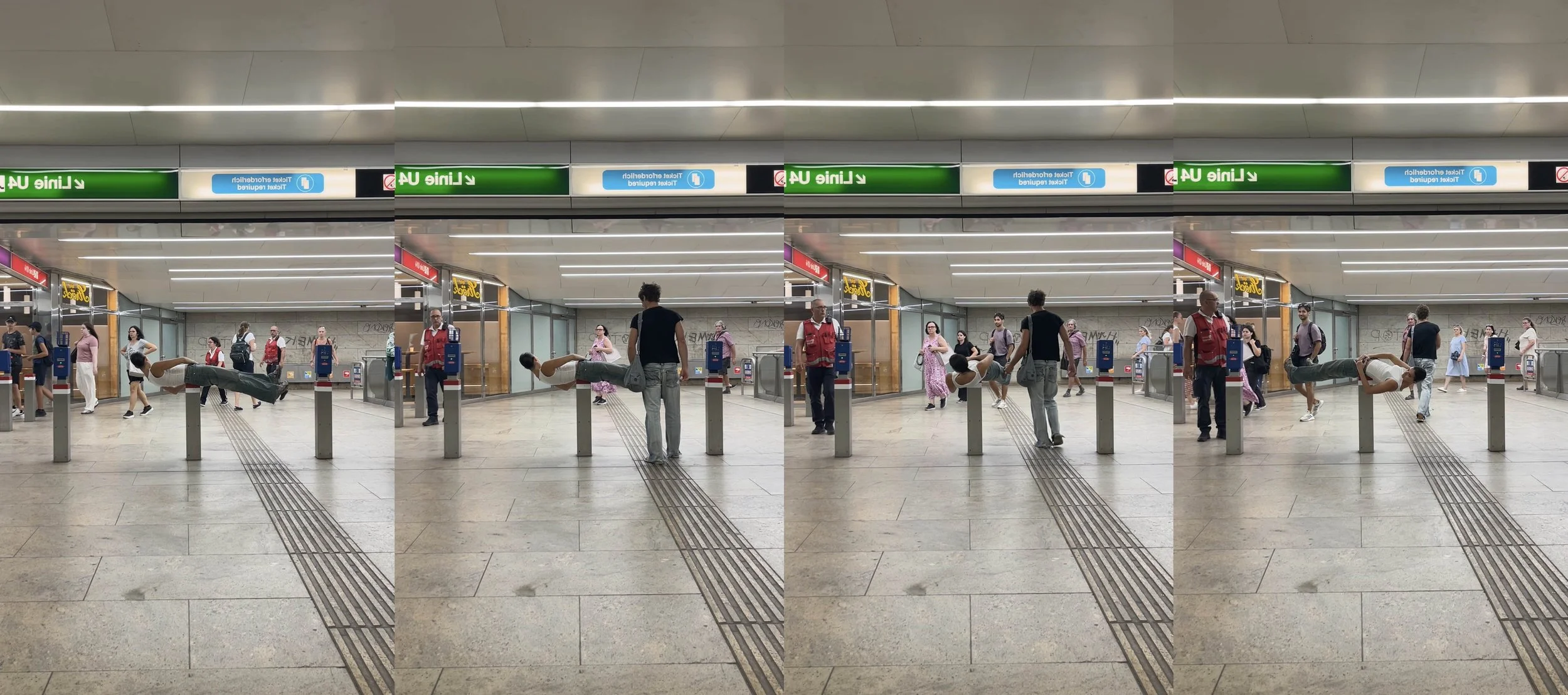
Can you introduce yourself, tell us about your background, and what led you to performance art?
I have always been involved in physical disciplines such as parkour, circus arts, and contemporary dance. This constantly evolving vocabulary was shaped through travel, encounters, and even YouTube tutorials. Over time, I felt the need to move beyond pure movement and develop a hybrid practice that brings together performance, visual arts, and choreography. Performance naturally emerged as a space where the body could become both a tool and a language — a way to engage directly with reality.
Are there particular disciplines, techniques, or influences that shape your work? (contemporary dance, theatre, parkour, artists…)
My work draws from parkour, circus arts, and contemporary dance, but also from urban culture and digital environments. I’m interested in practices that exist at the intersection of physical risk and poetic gesture. Beyond specific disciplines, I’m influenced by encounters, environments, and the spontaneity of real-life situations. Social media and contemporary visual culture also play a role, as they reshape how movement is perceived and shared.
Do you see your body as a medium capable of interacting fluidly with rigid obstacles? Is it a transgressive gesture, or rather a poetic way of approaching an abrupt urban reality?
I approach the body as a medium in constant dialogue with space. Rather than pure transgression, I see it as a way of reinterpreting rigid environments with lightness and poetry. By interacting fluidly with fixed or functional structures, the body creates a shift in perception. It disrupts the obvious and reveals alternative ways of inhabiting urban reality. There is both tension and vulnerability in this relationship — a balance between surrender and control.
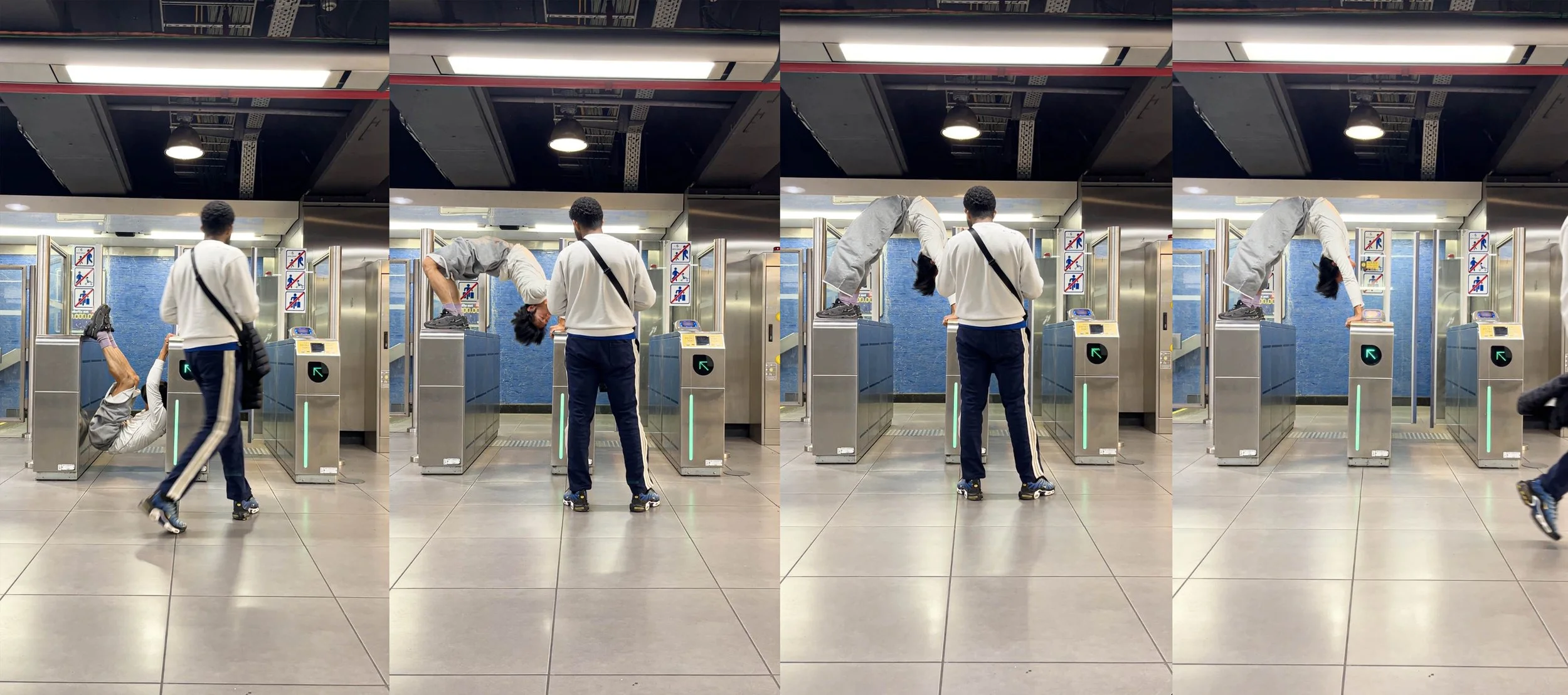
How do you choose the places, situations, or spaces where you perform? Are your performances spontaneous, or are they choreographed and anticipated beforehand?
I choose locations for their potential to generate tension or surprise. I look for spaces that carry implicit functions or strong symbolic weight. My performances exist in a balance between preparation and improvisation. There is always an awareness of the environment beforehand, but the final gesture emerges in the moment. I’m interested in that threshold where anticipation meets spontaneity, where the unexpected becomes part of the writing of the work.
What role does interaction with the public play in your creative process, whether in the street or through digital reactions?
Interaction is never peripheral — it’s a core component of the work. In public space, spectators often become co-present participants, sometimes without realizing it. Their gazes, movements, and reactions subtly reshape the performance, creating a collective and unstable choreography. Online, the dynamic shifts but remains essential. Social media extends the work beyond institutional spaces and activates it through visibility and circulation. The audience, whether physical or digital, becomes part of the ecosystem of the piece.
Discover Charles-Auguste’s work on Instagram